
Sixteen Years Post-Earthquake: A Reflection
Sixteen years ago today, Rev. Dr. Doug Hill had arrived in Port-au-Prince, Haiti. He, along with fourteen individuals from Haitian Timoun Foundation's community and Lutheran Seminary, traveled to Haiti that week; for some, this was their first visit to Haiti. What was planned to be an enriching immersion trip became an inciting moment in their lives and the life of HTF.
Pastor Doug is the Lead Pastor of Abiding Hope in Littleton, CO, HTF’s founding congregation. He has committed himself to building hope and sustainability for our friends and partners in Haiti. The generosity, strength, courage, and compassion he witnessed from the Haitians while they were experiencing life-changing devastation strengthened his love and commitment. Today, Pastor Doug shares his experience in Haiti on Jan 12, 2010.
We arrived in Port-au-Prince on Monday, January 11, 2010 having flown all night from Denver to Miami and then on a short, early morning flight into the Haitian capitol. There were 15 of us in the group, 13 students from four ELCA seminaries, a professor, and myself. We toured the city during the morning, visiting the Presidential Palace and National Museum. In the early afternoon we made our way up the mountain to Fermathe, to spend the night at Wings of Hope.
Very early Tuesday, January 12 we made the four-hour journey from Fermathe down to Jacmel so that we could experience Lekol Sen Trinite, a Montessori program serving children from the poorest families in Jacmel. The students greeted us with singing and playfulness. We shared candy, played games, and visited each of the classrooms. After a couple hours at the school, we then traveled over to Pazapa, a day-school for children with special needs. Again, we visited classrooms and interacted with the students and the staff.
At about 3:30 pm we settled into Hotel Florita, dropped our bags in our rooms, and began gathering in the bar/restaurant area to relax a bit. Several in the group expressed a desire to walk around Jacmel to see the town and meet some new friends. We left the hotel at 4:30 pm and were in the art district when we heard something strange.
The earthquake happened at 4:50 pm. It sounded at first like a very large diesel truck was barreling down the street. The street had a curve in it limiting our view and so we moved quickly to get out of the way. As we huddled up against a building so that we wouldn’t be run over by “the truck,” the earth began to shake, jump, and quiver beneath our feet. We would learn later that it was a 7.0 magnitude earthquake with the epicenter in Leogane, only about 15 miles north of our location. The earthquake lasted about 50 seconds, during which many of the cinderblock buildings around us were pulverizing and collapsing. The air got immediately thick with dust as sickening screams emanated through the air.
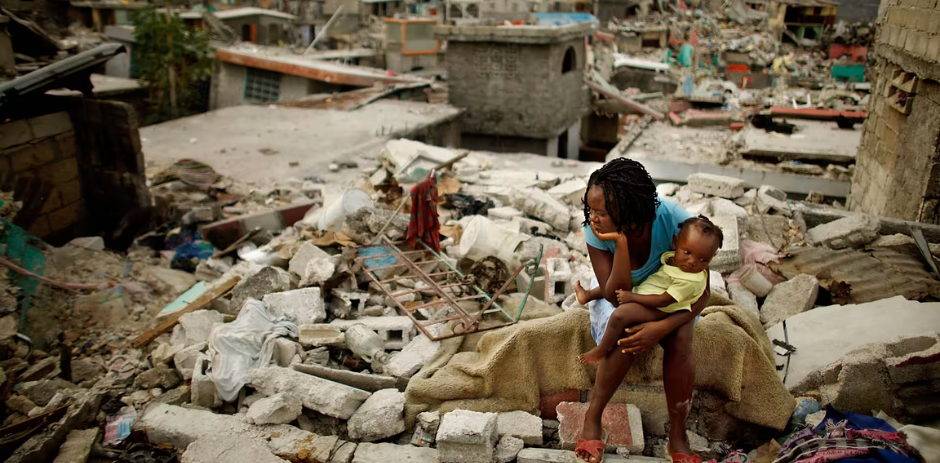
We huddled together in the middle of the street, keeping a close eye on the poorly hung powerlines overhead. When the shaking stopped, a few in our group started running toward the screams, wanting to offer help. I recognized that we still had four people back at Hotel Florita that we needed to get to immediately. We gathered our group and began to run, as best we could, back to the hotel.
When we got to the street of the hotel, huge mounds of concrete and debris blocked the street. We had to navigate around downed powerlines and the debris, careful not to touch anything that would cause electrocution or a collapse of the rubble. We found our friends standing in the front doorway of the hotel. Some had scrapes and bruises from part of the ceiling collapsing above them.
The back portion of the hotel had collapsed completely. Four people lost their luggage and possessions. The balcony on the front of the hotel was hanging, being held only by exposed rebar. We went into the building to retrieve everyone’s belongings that were still accessible. We stationed students at intervals on the stairs and passed the luggage down as quickly as possible.
Once we secured everyone’s possessions, we noticed people frantically digging in the area of the former kitchen. We learned that one of the cooks was trapped under the rubble and she was 8 months pregnant. We assisted in the effort to get the young women extricated and transported to the closest hospital. We learned later that she survived but she lost the baby.
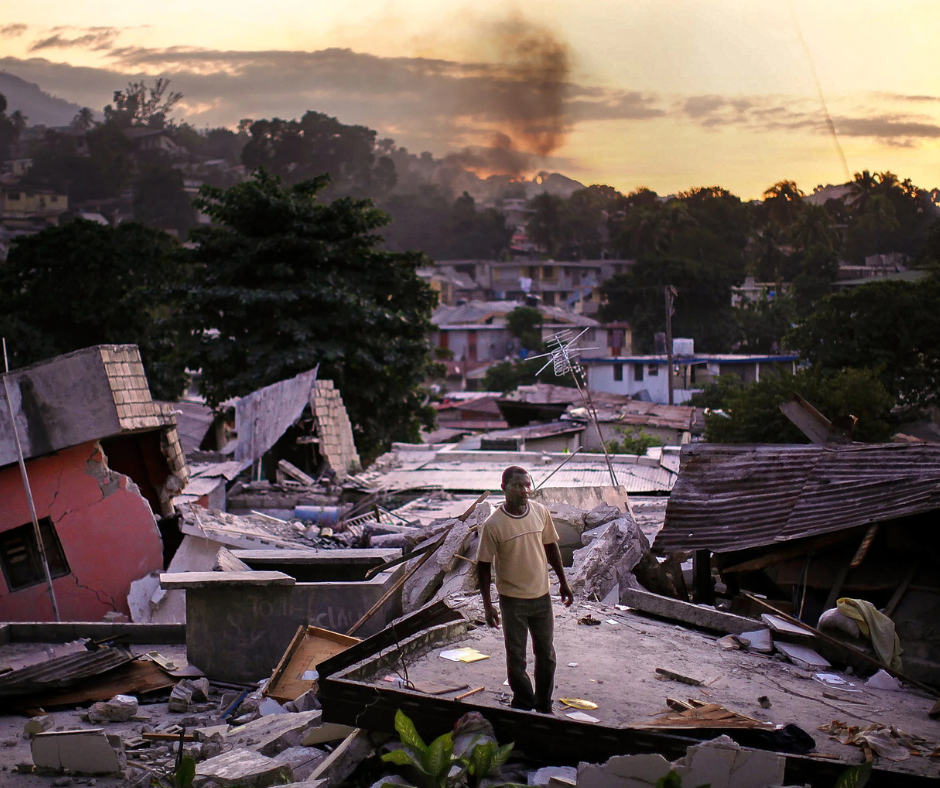
Not knowing where to go, we walked up the street toward the town center to figure out what was happening and what our next move should be. We didn’t know where the epicenter of the earthquake was and so we sought higher ground in case a tsunami was imminent. From the town center we decided to walk to Lekol Sen Trinite to unite with our Haitian friends. All of the students were gathered outside on a soccer field. We sang songs to try and keep everyone calm. Every so often aftershocks would occur resulting in the collapse of other buildings and more sickening screams from extraordinarily frightened people.
Just as it was getting dark, an unknown American arrived at Lekol Sen Trinite in a beat-up pickup truck. She informed us that the UN was setting up a refugee camp and makeshift hospital at the Jacmel airstrip. We packed as many people as possible into the back her truck and she made several trips to ferry us to the airstrip. We found a spot at the airstrip away from the crowds. Our Haitian friends were concerned for our safety. None of us knew the extent of damage and we feared how the crowds might react.
After a long sleepless night and recognizing that we weren’t in danger from the crowds, we moved our group toward a small grove of trees so that we could have some relief from the hot, Haitian sun. Some Haitians graciously loaned us a few blankets so that we didn’t have to sit on the dirt. Another Haitian gave us a sack of coconuts, another a bag of bread, and still another a jar of mamba (Haitian peanut butter) as they recognized that we had no food.
Later that day we were able to meet with leaders from the UN who strongly suggested that for our own safety we needed to be moved to a hotel that had not collapsed and was on the outskirts of town. The UN moved us during the middle of the night so as not to draw attention. We stayed at Hotel Cap Lamondou for three nights until we could formulate a plan to leave Haiti. We could not get to Port-au-Prince due to the rockslides covering the only road out of Jacmel. We also learned that the airport had been substantially damaged and no flights could come or go.
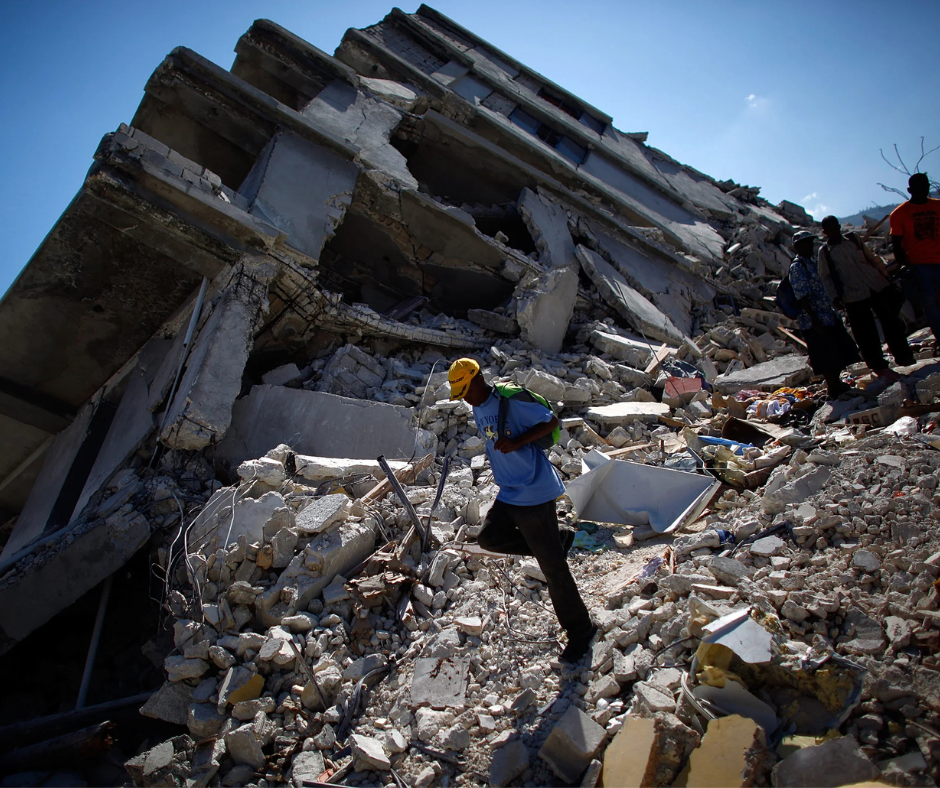
Pastor Rick Barger and his son, Robert, formulated a plan with our Haitian friends for us to go to a small fishing village to charter two small fishing boats that would take us to the border of the Dominican Republic. From the border we took an old bus for five hours to Santo Domingo. We remained there for two days before we could fly back to Denver.
We saw many horrible things during and following the earthquake. And we saw incredible acts of strength, courage, love, grace, and compassion on the parts of the Haitian people. We were foreigners, strangers in their land. Many Haitians had lost everything. And yet, the Haitians treated us as family, cared for us in our time of need, and shared with us what little they had. I will forever be grateful to our Haitian siblings and have committed myself to doing whatever I can to build hope and sustainability within Haiti.